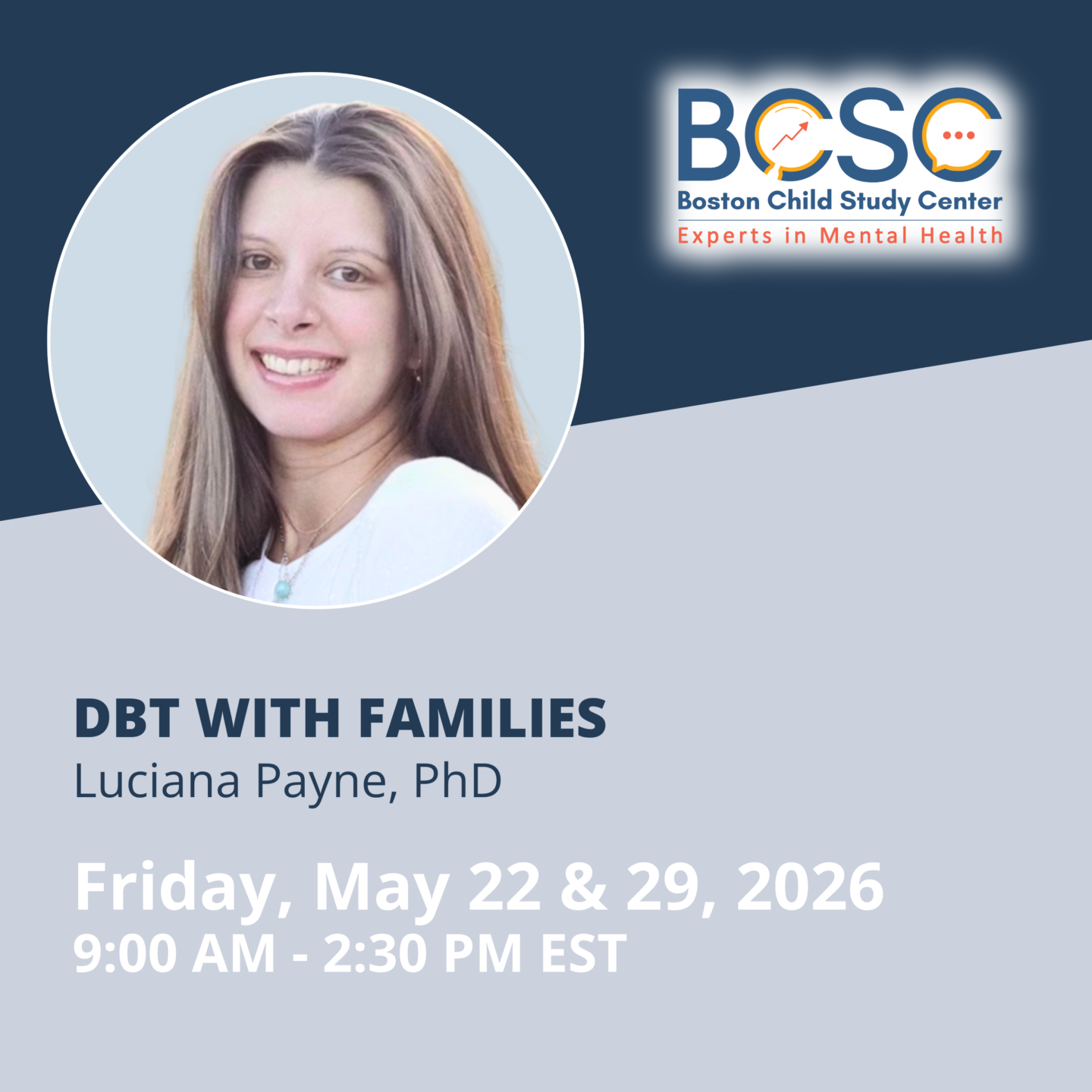
This intermediate training focuses on applying DBT principles and strategies in family therapy—helping clinicians assess family targets, conduct family sessions, and address transactional patterns of emotion dysregulation and invalidation while maintaining adherence to DBT principles. Participants will learn how to use their existing DBT knowledge to engage entire families, with special attention given to addressing clinicians’ hesitation and fears about family work and to developing confidence in using DBT with complex family systems.
Luciana Payne, PhD, is a Clinical Psychologist specializing in work with parents, couples, and families. Dr. Payne earned her graduate degree at the University of Nevada, Reno, and completed her postdoctoral fellowship at McLean Hospital, both under the mentorship of Dr. Alan Fruzzetti. She is currently an Instructor in the Department of Psychiatry at Harvard Medical School, where she contributes to research advancing interventions for families affected by emotion dysregulation. Dr. Payne has worked with hundreds of families and professionals to enhance the quality of care parents receive in adolescent and young adult treatment programs. She has co-authored multiple publications on adapting Dialectical Behavior Therapy (DBT) for couples and families and provides training to clinicians nationally and internationally. In 2020, she co-founded The Be Center, an organization dedicated to supporting parents and families navigating complex mental health challenges. Dr. Payne’s passion lies in bridging research and real-world practice—empowering parents, strengthening families, and changing the landscape of family treatment.

Instructional Level:
Target Audience: This educational activity is intended for behavioral health professionals, including Psychologists, Social Workers, Counselors, and MFT’s.
Continuing Education Credit:
Boston Child Study Center is approved by the American Psychological Association to sponsor continuing education for psychologists. Boston Child Study Center maintains responsibility for this program and its content.
To receive continuing education credit for this program, participants must attend the program in its entirety and complete the required program evaluation. Partial credit will not be awarded.
Each participant is responsible for determining whether this program meets the continuing education requirements established by their individual licensing board or regulatory agency.
American Psychological Association
Boston Child Study Center is approved by the American Psychological Association to sponsor continuing education for psychologists. Boston Child Study Center maintains responsibility for this program and its content.
Participants who meet attendance requirements will receive a link to complete the program evaluation following the event. Continuing education certificates will be issued electronically upon completion of the required evaluation.
Registration Fee: $500
Cancellation: If Boston Child Study Center cancels or reschedules this program, registered participants will be notified using the email address provided during registration.
If you are no longer able to attend, we ask that you cancel your registration so that we can maintain accurate attendance records.
Boston Child Study Center is committed to providing accessible continuing education programs. Participants who require accommodations to participate in a program may contact Beth Jerskey (bjerskey@bostonchildstudycenter.com) with their request. Please submit accommodation requests as early as possible to allow adequate time for arrangements.
The Boston Child Study Center (BCSC) is fully committed to conducting all activities in strict conformance with the American Psychological Association’s Ethical Principles of Psychologists. The BCSC will comply with all legal and ethical responsibilities to be non-discriminatory in promotional activities, program content and in the treatment of program participants. The monitoring and assessment of compliance with these standards will be the responsibility of Dr. Beth Jerskey in consultation with the members of the continuing education committee.
While the BCSC goes to great lengths to assure fair treatment for all participants and attempts to anticipate problems, there will be occasional issues that come to the attention of the convention staff which require intervention and/or action on the part of the convention staff or an officer of the BCSC. This procedural description serves as a guideline for handling such grievances.
If you wish to file a grievance, please note that the following actions will be taken:
1. If the grievance concerns a speaker, the content presented by the speaker, or the style of presentation, please put your comments in written format and provide them to Dr. Jerskey. Dr. Jerskey will then pass on the comments to the speaker, assuring your confidentiality.
2. If the grievance concerns a workshop offering, its content, level of presentation, or the facilities in which the workshop was offered, the convention chair will mediate and will be the final arbitrator. If you request action, Dr. Jerskey will:
a. attempt to move you to another workshop, or
b. provide a credit for a subsequent year’s workshop, or
c. provide a partial or full refund of the workshop fee.
Actions 2b and 2c will require a written note, documenting the grievance, for record keeping purposes. The note need not be signed by you.
3. If the grievance concerns the BCSC CE program, in a specific regard, Dr. Jerskey will attempt to arbitrate.
To contact Dr. Jerskey or other members of the Continuing Education Committee, please call (617) 800-9610.
Correspondence can be sent to Dr. Beth Jerskey, 729 Boylston Street, Fifth Floor, Boston, Massachusetts, 02116.
Virtual programs are delivered live via Zoom. Participants are responsible for having a reliable internet connection and a device capable of accessing Zoom. We recommend using the most recent version of Zoom and joining several minutes before the scheduled start time.
Attendance is monitored electronically. Participants must attend the live program for the required duration to receive continuing education credit.
By joining this event, you agree to Zoom’s Event Participant Terms of Use, Privacy Statement, and Terms of Service.
For questions about continuing education, registration, or this program, please contact the BCSC Continuing Education Team at ce@bostonchildstudycenter.com.