Continuing Education & Professional Development
Expert-led training programs designed to equip mental health professionals with practical skills and in-depth knowledge in evidence-based treatments for children, adolescents, and families.
Looking to continue your education or professional development? BCSC offers a variety of courses & professional opportunities.
How It Works:
The Boston Child Study Center (BCSC) is an evidence-based treatment, training, and research center dedicated to improving the lives of children, adolescents, young adults, and families through innovative empirically-supported treatments and assessments. BCSC is approved by the American Psychological Association (APA) to sponsor continuing education for psychologists. We maintain responsibility for this program and its content.
We are fully committed to conducting all activities in strict conformance with the APA’s Ethical Principles of Psychologists. We comply with all legal and ethical responsibilities to be non-discriminatory in promotional activities, program content, and in the treatment of program participants. View our Continuing Education Grievance Procedures for more information.
Why Consider Continuing Education & Professional Development at BCSC?
- Advance your career
- Receive training at multiple locations
- Enhance your knowledge of evidence-based treatment
Courses:
DBT with Families
This intermediate training focuses on applying DBT principles and strategies in family therapy—helping clinicians assess family targets, conduct family sessions, and address transactional patterns of emotion dysregulation and invalidation while maintaining adherence to DBT principles. Participants will learn how to use their existing DBT knowledge to engage entire families, with special attention given to addressing clinicians’ hesitation and fears about family work and to developing confidence in using DBT with complex family systems.
Luciana Payne, PhD
Registration: https://boston-child-study-center.ce-go.com/dbt-with-families
Date & Time: May 22 and 29, 2026 from 9 am-2:30 pm EST
Credits: 10 CE Credits will be awarded for full attendance
Cost: $500
Trauma-Focused Cognitive Behavior Therapy for Children and Adolescents: A Comprehensive Review of the Leading Evidence-based Treatment for Childhood Trauma
This immersive, introductory three-day training provides clinicians with a thorough, practice-oriented foundation in Trauma-Focused Cognitive Behavioral Therapy. Participants will learn the core components of the TF-CBT model, develop skills for engaging children, adolescents, and caregivers, and gain confidence in implementing the PRACTICE framework. Clinicians will gain clinical strategies designed to bolster their competence in working with children exposed to childhood sexual abuse, physical abuse, and neglect; domestic violence or other forms of intimate partner violence; traumatic grief; and other types of psychological trauma. Through interactive instruction, case examples, demonstrations, and guided role-plays, attendees will deepen their understanding of the impact of childhood trauma on child development. They will also master their use of evidence-based strategies for assessment of post-traumatic stress and its sequelae, affect recognition and modulation, cognitive processing, and written trauma exposure through the trauma narrative. Participants will be invited to attend monthly case consultation/ supervision with Dr. Michael Gomez, a national trainer in TF-CBT, and Dr. Brian Denietolis, Senior Expert in TF-CBT at BCSC. By the end of the training, participants will be equipped with practical tools and clinical techniques to deliver TF-CBT effectively and sensitively in diverse treatment settings.
Michael Gomez, Ph.D. National Trainer in TF-CBT
Brian Denietolis, Psy.D. Director of Trauma-Informed Cognitive Behavioral Services at BCSC
Registration: https://boston-child-study-center.ce-go.com/tfcbt2025/home
Date & Time: December 9-11, 2025 from 10am-5pm EST
Credits: 18 CE Credits will be awarded for full attendance
Cost: $600
Dialectical Behavior Therapy 4-Day Training
This immersive, introductory in-person four-day workshop will introduce participants to the foundational principles and techniques essential to provide Dialectical Behavior Therapy (DBT) to fidelity with an emphasis on working with adolescents and families. Developed by Dr. Marsha M. Linehan, DBT is an evidence-based treatment that integrates cognitive-behavioral techniques with mindfulness and acceptance practices, tailored to help individuals reduce life threatening behaviors, manage intense emotions, improve relationships, and enhance overall quality of life. This training is designed to be accessible and beneficial for both newcomers to DBT and practitioners with experience who are seeking to deepen their understanding and enhance their skills with adolescents.
Lyndsey Moran, PhD
Date & Time: September 15-18, 2025 from 9:00am-3:30pm
Credits: 20 CE credits will be awarded for full attendance on all four days.
Cost: Professionals
- Early Bird Professionals – $825 before August 16
- Regular Professionals – $975 after August 16
Cost: Students
- Early Bird Student – $600 before August 16
- Regular Student – $700 after August 16
Ketamine-Assisted Psychotherapy: Foundations and Frameworks from ACT and DBT
This webinar will provide an introduction to ketamine-assisted psychotherapy (KAP) using components of ACT and DBT. Primary topics will include a brief history and the biological mechanism of ketamine, treatment components of KAP (i.e., intake, preparation, dosing, integration), and the role of the KAP therapist (i.e., preparation, set & setting, guiding dosing sessions, conducting integration W/ACT & DBT). Components of ACT & DBT will be introduced as tools to facilitate KAP throughout all phases of treatment.
Christopher Rutt, PhD and Caitlin Wilds, MD
Registration: https://boston-child-study-center.ce-go.com/introkap2025
Date & Time: August 12, 6:30-8:00pm EST
Credits: 1.5 CE credits will be awarded for full attendance
Cost: $45
Transdiagnostic Interventions for Trauma and Emotion Disorders: Utilizing Ketamine-Assisted Therapy
This introductory seminar will discuss the gaps in research on evidence-based treatments for trauma and emotion disorders as well as the review of the transdiagnostic model to utilize with Ketamine-Assisted Therapy for bridging the gaps in treatment outcomes.
The learning objectives for this seminar are as follows:
- Participants will have a better understanding of the transdiagnostic mechanism of trauma and emotion disorders.
- Participants will be able to describe elements of evidence-based trauma interventions and limiting barriers.
- Participants will be able to discuss the benefits of ketamine-assisted therapy as an innovative tool for improving trauma treatment outcomes.
- Participants will be able to examine parenting strategies and adolescent brain development in relation to mental health interventions.
Candice Feinberg, Psy.D. and Ryan J. Madigan, Psy.D.
Registration:
Date & Time: Thursday, February 27, 2025 from 3:00–4:30pm EST
Credits: 1.5 CE credits will be awarded for full attendance
Cost: Free
Gender-Affirming Psychotherapy (GAP) Training
Transgender and nonbinary youth – defined as children, adolescents, and young adults whose gender is not aligned with their birth-assigned sex – benefit from supportive and affirming practices in psychotherapy, yet few resources exist for helping providers learn these practices. The Gender-Affirming Psychotherapy (GAP) Training is an online training that is modular and self-paced. It uses patient, parent, and provider testimonials and interactive practice activities to teach the key practices to better support transgender and nonbinary youth clients and their parents.
At the end of the training participants will be able to:
- Articulate when to ask for a client’s affirmed name and pronouns.
- Identify two potentially harmful questions that are commonly asked in sessions with transgender and nonbinary clients.
- Compile a list of local resources for caregivers of transgender and nonbinary youth.
- Articulate to a client what it means to receive a gender dysphoria diagnosis.
- Make an action plan for how to help transgender and nonbinary clients develop and practice their self-advocacy skills.
- Practice creating a diagram of social support and provide examples of how to change the intake process to be more accessible.
Registration: Closed
Instructor: Maggi Price, PhD
Date & Time: Online and asynchronous
Credits: Users must complete all 12 modules to receive CE credits. 8 CE credits will be awarded by APA and NASW. 9.5 credits will be awarded by NBCC. No credit will be given for partial completion.
Cost: $200 for all 12 modules or $20 per module (note: there are no CE credits available for individual modules).
Questions? Email GenderAffirmingTraining@gmail.com
Parent-Child Interaction Therapy (PCIT) Training
BCSC offers PCIT training for clinicians who are interested in applying the PCIT model at their agency. The training is for therapists who have a minimum of a Master’s degree in mental health (e.g., social work, counseling) and are licensed within their respective field. If not licensed, the therapist must be supervised by a licensed clinician. Doctoral students need to have completed three years of training and must be supervised by a licensed clinician.
PCIT training is conducted by PCIT-International Global Trainers and involves a 5-day workshop (across two sessions), videotape review of targeted sessions, and ongoing consultation to assist with clinical, organizational, and technology-related issues to help with treatment fidelity and sustainability. This training period is up to 14 months.
For more information, please send an email to jmasse@bostonchildstudycenter.com
Child-Adult Relationship Enhancement (CARE) Training
Child-Adult Relationship Enhancement (CARE) is a trauma-informed, field-initiated modification of specific positive parenting practices. Many of practices are also used in evidence-based, therapeutic parenting programs such as Parent-Child Interaction Therapy (PCIT). While CARE uses many of the same ideas and skills, CARE is not a therapy program, a treatment, or a structured intervention. CARE is a way for any adult to cultivate a relationship with any child and modify behavioral difficulties.
CARE training workshops can be at your preferred location or at our office and can take one of two forms listed below. The training level is varied based on the setting, client population, and agency goals.
- 3-4 hours: Lecture, demonstrations, and practice.
- 6 hours: Lecture, demonstrations, practice, and live coaching. This can be split into (2) 3-hour sessions.
For more information, please send an email to jmasse@bostonchildstudycenter.com
Questions? For more information, call (617) 800-9610.
Note for APA Continuing Education: Boston Child Study Center is approved by the American Psychological Association to sponsor continuing education for psychologists. Boston Child Study Center maintains responsibility for this program and its content. There is no known commercial support for this program.
Check Out Our Blog

Supporting Children and Teens Through Summer Transitions: Balancing Flexibility and Structure
The transition from the school year into summer can feel like a welcome break, but for many children, teens, and families, it also brings a sudden shift in routine, expectations, and structure. While summer often offers more flexibility, most children and adolescents actually function best with a balance of predictability
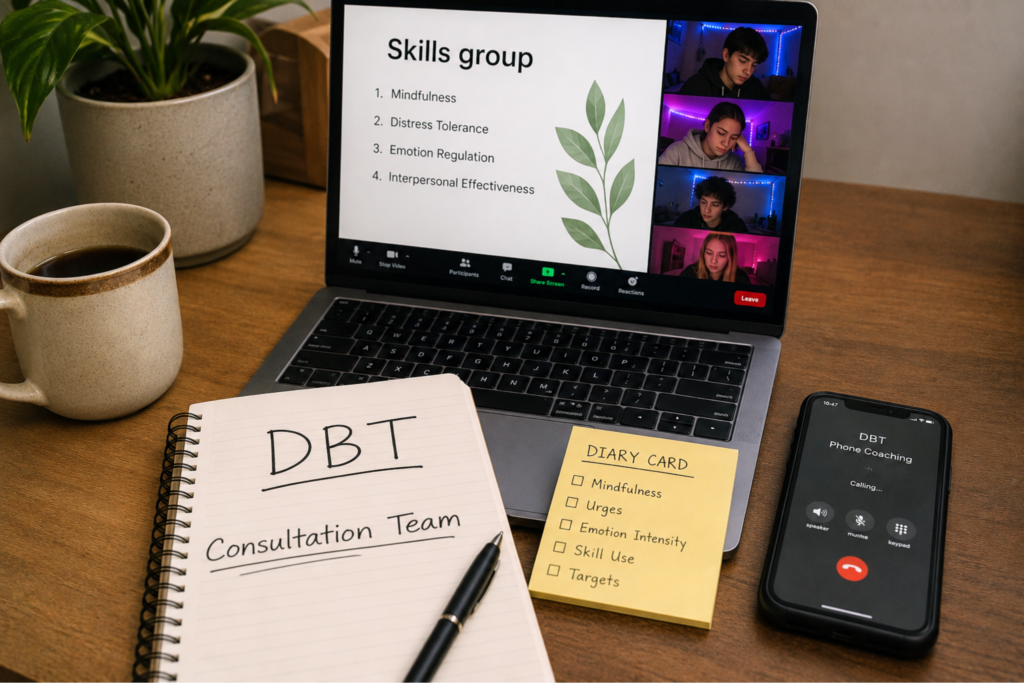
What Makes a “Good” DBT Program?
Dialectical Behavior Therapy (DBT) is one of the most well-researched treatments for individuals experiencing chronic emotion dysregulation, self-harm, and suicidal behaviors. However, not all DBT programs are the same, and outcomes depend heavily on how closely a program adheres to the evidence-based model. DBT is not simply a set of

How Summer Camp Supports Emotional Growth in Kids
Summer camp is often thought of as a place for fun, adventure, and making memories. Beyond the games, crafts, and campfires, summer camp also provides a unique environment that supports social, emotional, and psychological development in ways that are hard to replicate in other settings. Research suggests that structured summer